
Facing a Tech IPO? What an Anthropic or OpenAI Windfall Means for Your Taxes — and Why Some Are Moving to Nevada
Lake Tahoe Cole Mizak September 17, 2026
Lake Tahoe Cole Mizak September 17, 2026
By Cole Mizak, Compass | #1 agent by individual sales volume in Incline Village, 2025
This article is general information, not tax, legal, or financial advice, and every situation is different. The strategies below are complex, fact-specific, and easy to get wrong. If a liquidity event is on your horizon, work with a qualified cross-border tax attorney and CPA before making any decision — ideally one to two years ahead. Company IPO plans described here are based on public reporting and are subject to change.
TL;DR: With high-profile AI companies reportedly moving toward the public markets — Anthropic has been reported to be tracking a potential 2026 listing, and OpenAI a later one, both after confidential filings — a wave of Bay Area employees and founders is looking at life-changing liquidity. Where you legally reside when you eventually sell shares can be worth a great deal, because California taxes capital gains at up to 13.3% and Nevada has no state income tax. But an IPO is not a single tax event, and the honest answer is nuanced: relocating to Nevada can protect the future appreciation on shares you hold and sell as a Nevada resident, and can matter enormously for early founders with qualifying stock — but it generally cannot erase California's tax on the equity compensation you earned while working in California. Understanding that distinction, early, is what separates a smart plan from an expensive misunderstanding.
The prospect of public offerings from the largest private AI companies has put a spotlight on something thousands of Bay Area employees are quietly thinking about: what a liquidity event will mean for their finances, and where they should be living when it happens. Public reporting indicates both Anthropic and OpenAI have taken formal early steps toward the public markets, with timing still uncertain and clearly in flux. Whether those specific listings happen in 2026, 2027, or later, the broader reality is that a large cohort of equity holders is heading toward a windfall — and taxes will determine how much of it they keep.
Nevada's zero-income-tax shore of Lake Tahoe has become one of the places they're looking. But before anyone packs a moving truck, it's worth understanding exactly what a move does and doesn't do — because an IPO windfall is taxed very differently depending on what kind of equity you hold.
Nevada has no state income tax of any kind — no tax on wages, capital gains, or business income. California has one of the highest state income tax rates in the country and taxes capital gains as ordinary income, at rates up to 13.3%. On a large equity payout, the gap between selling shares as a California resident and as a Nevada resident can be one of the biggest numbers in the entire event.
That's the appeal in one sentence. The complication is that an IPO doesn't create one clean pool of "gain." It creates several different kinds of income, and they don't all follow the same rules.
If you take one thing from this article, make it this. Your IPO-related equity generally falls into two buckets, and California treats them very differently:
Equity compensation earned in California is California income — wherever you move. RSUs, non-qualified stock options, and similar equity are a form of pay. When you earned them by working in California, California sources that income to the state and allocates it based on your California workdays during the vesting or earning period. It can tax that portion regardless of where you live when the shares vest or you sell. Moving to Nevada the year before an IPO does not undo California's claim on compensation you already earned while working there.
Capital gain on shares is sourced to where you live when you sell. Once you own the shares, any further appreciation you realize by selling them later is a capital gain — and capital gain on stock is generally sourced to your state of residency at the time of sale. A genuine Nevada resident who holds shares after an IPO and sells them later can generally have that post-move appreciation sourced to Nevada, not California.
So the realistic play for most employees isn't "move and pay zero." It's "move, correctly, and shift the future appreciation on the shares you continue to hold out of California's reach" — while recognizing that the compensation element you earned in California will likely still be taxed there. For someone holding a large position through a lockup and beyond, that future-appreciation piece can still be very significant. But it has to be understood honestly.
There's one group for whom a move can be far more powerful: early founders and very early employees holding Qualified Small Business Stock.
Under federal Section 1202, QSBS held for five years can potentially be excluded from federal capital gains tax up to generous limits. Here's the California trap: California does not conform to QSBS at all. A founder can owe $0 federal tax on a qualifying gain and still owe California up to 13.3% — roughly $1.33 million on a $10 million gain. For a genuine Nevada resident, that California bill can go to zero, because the gain is sourced to Nevada.
The important caveat for AI-company equity specifically: QSBS requires that the company's gross assets were under a threshold ($50 million, or $75 million for stock issued after mid-2025) at the time the stock was issued. That means only equity received when the company was still small — in its earliest days — can qualify. Recent grants at companies now valued in the hundreds of billions do not. So QSBS is a founder-and-earliest-employee consideration, not something most later employees can rely on. And unusual corporate structures — the kind some AI companies have used — can complicate QSBS eligibility further. This is squarely a question for specialized tax counsel.
Beyond the compensation-versus-gain distinction, an IPO introduces timing factors that a private sale doesn't:
Lockups. Employees typically can't sell for a period after the IPO — often around six months. That lockup window is, in practice, time you may be able to use to establish genuine Nevada residency before you sell, if a move is right for you. But it has to be a real relocation, not a countdown-clock maneuver.
The move must be genuine and precede the sale. California determines residency by a facts-and-circumstances domicile test and presumes your California domicile continues until you prove you've abandoned it. The Franchise Tax Board audits people who relocate around liquidity events aggressively, can look back several years, and counts partial California days as full days. Establishing real Nevada residency means making Nevada your actual home — driver's license, voter and vehicle registration, where your family lives, where your life is centered — not a second address. Done properly, it's entirely legitimate. Done as theater, it fails.
Market volatility is real. Recent mega-cap technology listings have been volatile, and a post-IPO share price can move sharply in either direction. Any plan built around holding shares through a lockup carries market risk that has nothing to do with taxes. That's a financial-advisor conversation, and an important one.
If you're an early founder with qualifying stock, the case for establishing Nevada residency before you sell can be extremely strong, and the time to plan is one to two years ahead — well before any transaction is locked in.
If you're an employee with RSUs or options, the picture is more nuanced. A move likely won't change California's tax on the compensation you earned there, but it can meaningfully affect the tax on future appreciation of shares you hold and later sell as a Nevada resident. Whether that's worth relocating for depends on the size of your position, your plans for holding, and your life — which is exactly why this is a conversation for you, a cross-border tax attorney, and a financial advisor, not a decision to make off a blog post.
Either way, the people who come out ahead start early, while there's still time to structure everything correctly.
I'm not your tax attorney, and this isn't tax advice — my role is the real estate and relocation side, and connecting you with the professionals who handle the rest. In practice, that means helping you establish a genuine Nevada home base on the Lake Tahoe shore that holds up to scrutiny, finding the right property on the timeline your situation requires, and coordinating with the cross-border tax and legal advisors who structure the move correctly. A large share of my practice is exactly this buyer — Bay Area technology founders and executives thinking through a Nevada move around an equity event — so I understand how the home purchase has to fit the larger plan.
Incline Village and Crystal Bay offer something rare: genuine no-state-income-tax residency in a world-class lakefront setting, a 45-minute drive from a major airport and a few hours from the Bay Area, close enough to keep your professional life intact through a transition. If a liquidity event is on your horizon, the time to build the plan is now.
If my company IPOs, can I avoid California tax by moving to Nevada? Partially, and it depends on what you hold. Equity compensation (RSUs, options) you earned while working in California generally remains California-taxable wherever you move. But capital gain on shares you hold and sell as a genuine Nevada resident is generally sourced to Nevada, which has no income tax — so a real, well-timed move can protect future appreciation. Consult a cross-border tax attorney.
Do Anthropic or OpenAI employees qualify for the QSBS exclusion? Only in limited cases. QSBS requires the stock to have been issued when the company's gross assets were under roughly $50–75 million — meaning only the earliest founders and employees could hold qualifying stock. Equity granted once these companies grew large does not qualify, and unusual corporate structures can complicate eligibility further. This is a question for specialized tax counsel.
When should I move if I expect an IPO? As early as realistically possible — one to two years ahead is the standard guidance for founders. For employees, the post-IPO lockup period may offer a window to establish genuine residency before selling. In all cases, the move must be a real relocation completed before the sale, or California can still tax the proceeds.
Will California audit me if I move to Nevada around an IPO? Quite possibly. The Franchise Tax Board scrutinizes liquidity-event relocations closely and examines your ongoing California ties. A genuine, well-documented move is defensible; a last-minute or paper move is not.
Are these AI companies definitely going public in 2026? No. Public reporting indicates both have taken early, confidential steps toward the public markets, but timing is uncertain and has shifted — reporting has pointed to a possible 2026 listing for one and a later timeline for the other. Treat any specific date as tentative and verify current information.
I'm Cole Mizak, a Compass luxury agent and the #1 agent by individual sales volume in Incline Village for 2025, with more than $250 million in career sales. I'm dual-licensed in Nevada and California, and I specialize in helping technology founders and executives establish a genuine Nevada home base on the Lake Tahoe shore — coordinated with the tax and legal professionals who make a pre-liquidity relocation sound and defensible.
If an IPO or other equity event is on your horizon, let's talk early, while there's still time to do it right. Reach out at mtnluxuryliving.com for a confidential conversation. You may also want to read my guide to moving to Incline Village from the Bay Area and my guide for founders establishing Nevada residency before an exit.
Reminder: This article is general information, not tax, legal, or financial advice, and takes no position on any specific company, transaction, or investment. Company IPO plans are based on public reporting and subject to change. Tax and residency outcomes are highly fact-specific. Consult a qualified cross-border tax attorney, CPA, and financial advisor before making residency, transaction, or investment decisions.
Stay up to date on the latest real estate trends.

Lake Tahoe
October 7, 2026
Closed sales, Incline Village only, one agent: $68M+ year to date as of 10/07/2026 from MLS data.

Lake Tahoe
October 6, 2026
The June 4, 1968 boundary rule, 2026-27 IVGID fees, and how to verify a property before you write an offer.
Lake Tahoe
September 30, 2026
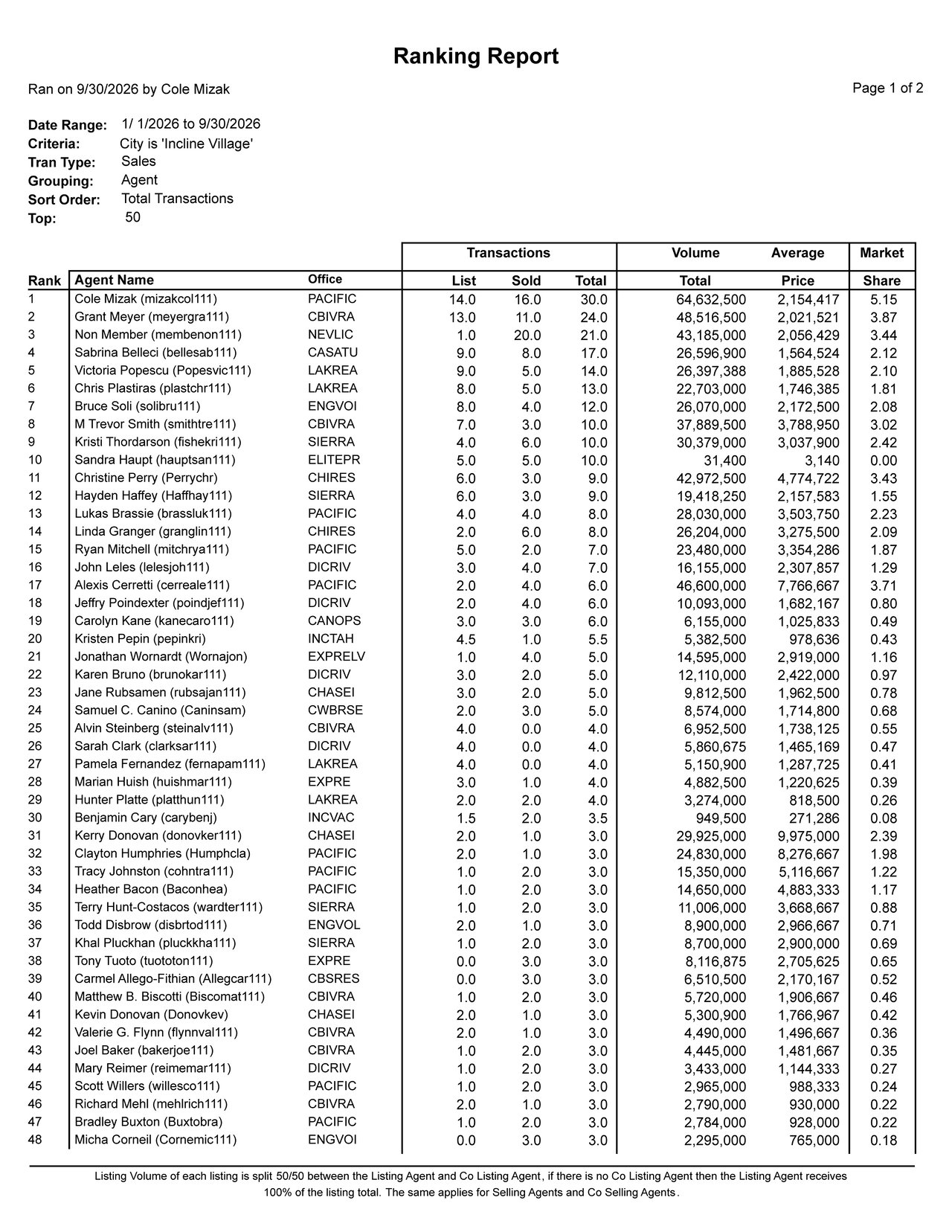
The official IVR MLS rankings are in — who leads Incline Village through three quarters, and what the data means for buyers and sellers.

Lake Tahoe
September 18, 2026
Effective October 15, 2026 — but the statewide average hides who really pays. Here's what it means on each side of the lake.
Lake Tahoe
September 17, 2026
Where you live when you sell can be worth millions — but an IPO windfall isn't taxed the way most people think. Here's what a move can and can't do.

Lake Tahoe
September 15, 2026
Incline's most walkable, family-friendly single-family neighborhood — and its top spot for teardown-and-rebuild.

Lake Tahoe
September 8, 2026
Trophy estates from $10M to a $125M record — and why, on this street, value is measured in feet of frontage, not square feet.

Lake Tahoe
September 3, 2026
Property taxes, IVGID fees, insurance, and rental rules — the full annual carrying cost, and why it often nets out in your favor.

Lake Tahoe
August 31, 2026
How Much Is My Incline Village Home Worth? (2026)
Cole’s mission is to elevate the real estate experience for his clients. He is a long-time Lake Tahoe local and luxury home expert who has developed innovative strategies to provide his clients with an unmatched, bespoke level of service, attention, and support.